Erika Kirk Tearfully Condemns Those Celebrating Her Husband Charlie Kirk’s Death, Calling the Online Mockery “Sick” as She Shares the Pain Her Family Now Carries
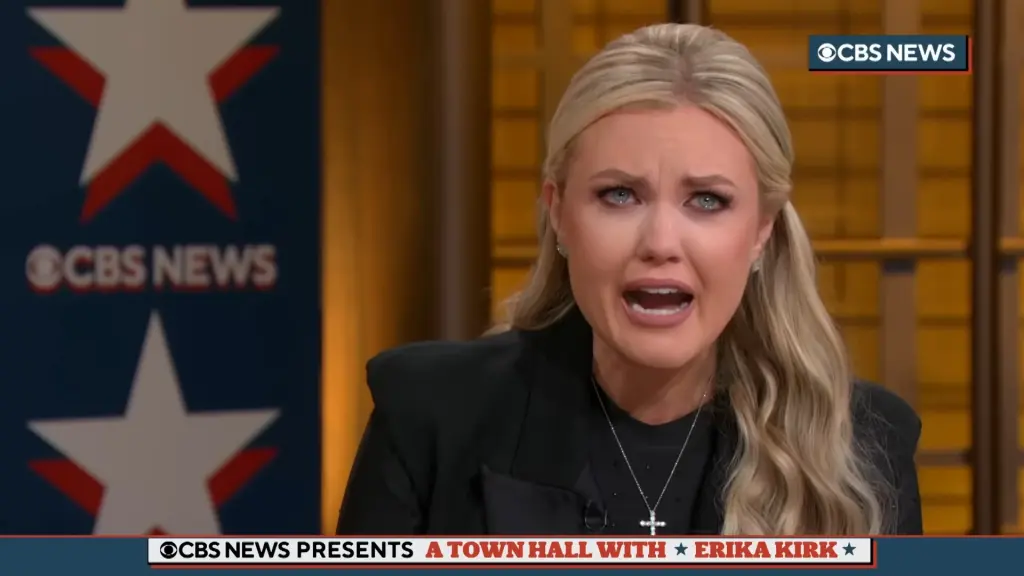
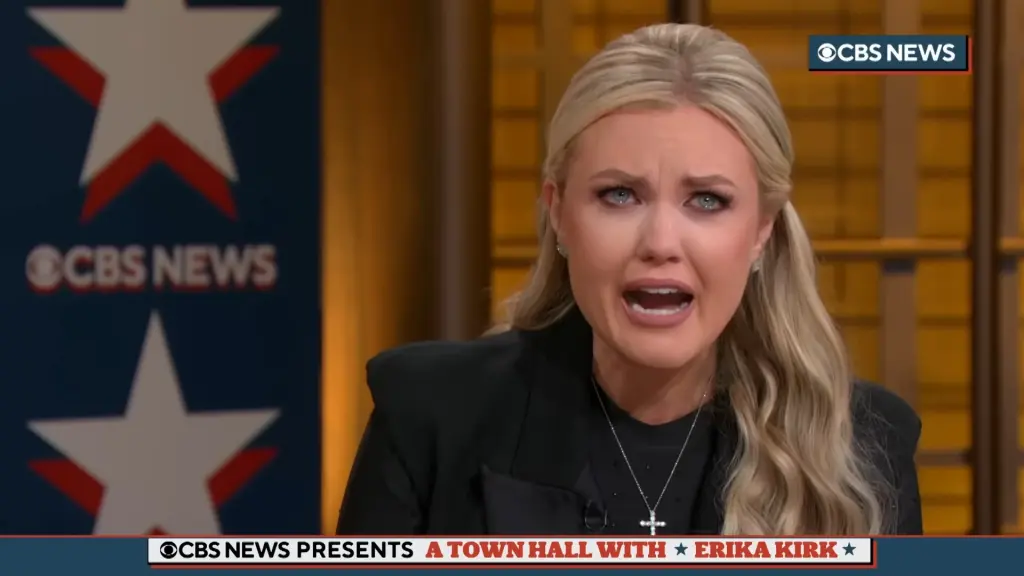
Erika Kirk’s voice trembled long before her tears appeared, but when they finally did, they told a story words alone couldn’t. Sitting under the bright studio lights during a televised town hall moderated by CBS News Editor-in-Chief Bari Weiss, she faced an audience still grappling with the aftermath of her husband Charlie Kirk’s assassination. What had begun as a difficult conversation about grief and political tension quickly shifted into a raw and deeply emotional rebuke of the online reactions that followed his death—reactions that stunned her almost as much as the tragedy itself.

Charlie Kirk’s shooting, captured from several angles by bystanders and shared rapidly across social platforms, ignited a political firestorm even before authorities released full details. But for Erika, the digital frenzy wasn’t just another round of national argument. It was an intrusion into the most devastating moment of her life. When Bari Weiss asked her what she would say to those who attempted to justify or even mock Kirk’s killing, Erika didn’t hesitate. Her answer came sharp, emotional, and painfully human.
“You think he deserved that?” she said, her voice cracking as tears rolled down her cheeks. “Tell that to my 3-year-old daughter.”
In that moment, the room fell silent. Gone was the polarization that so often clouds conversations about public figures. All that remained was a grieving young mother trying to make sense of a cultural moment that seemed to have lost its ability to recognize pain.
Erika went on to describe the shock she felt when she first saw strangers celebrating the violence. She said she had expected debate, criticism, and heated discussion—Charlie was a controversial figure who thrived at the center of national discourse—but what she encountered was something darker. She called it a symptom of “internet culture,” a digital environment where people seem to forget that behind every headline and every political position, there are real families, real children, and real futures now forever altered.
“It felt like people weren’t reacting to a human being,” she said. “They were reacting to a character they made up in their heads. And that’s what scares me.”
For many viewers, Erika’s anguish served as a sobering reminder of the widening divide between online commentary and real-world consequences. The assassination had already sparked a national debate about political extremism, public safety, and the rising threat of targeted violence, but Erika’s remarks shifted the conversation to a deeper question: Have we become desensitized to human life when it’s filtered through a screen?
Friends of the Kirk family told reporters that the couple had been preparing for a quiet end to the year with their children, hoping to step outside the spotlight during the holidays. Instead, Erika now finds herself navigating a world where every memory of her husband exists alongside endless online debates, theories, and—in some places—celebrations.
Those who worked closely with Charlie remember him as someone who thrived on confrontation in the arena of ideas but was devoted and gentle at home. The distinction has become important for Erika as she raises their young children, one of whom is still too young to understand any part of what has happened. She shared that the hardest conversations are yet to come, and she worries about how to explain not only their father’s death but the public response to it.
During the town hall, Bari Weiss listened attentively, giving Erika the space to speak freely without interruption. Weiss later commented that the widow’s remarks reflected a larger cultural crisis—one where empathy fractures under the weight of digital tribalism. The viral spread of the shooting video only amplified the problem, turning a traumatic moment into what Erika called a “spectacle that people reacted to like entertainment.”
She expressed particular heartbreak over the way some individuals justified the killing by citing political disagreements. For Erika, those explanations felt like an attempt to erase her husband’s humanity in order to validate cruelty. She said the reactions revealed a disturbing comfort people now seem to have with violence when it aligns with their ideology.
“There’s no justification for celebrating a death,” she insisted. “We’ve lost something as a society if we think it’s acceptable to cheer when someone is murdered.”
Investigators have continued releasing details about the shooting, though authorities have urged the public to avoid making assumptions while the case develops. Meanwhile, security and political analysts have warned that public reactions to high-profile assassinations—especially when amplified by social media—can further escalate tensions across the country.
For Erika, navigating this new landscape feels surreal. She spoke about the exhaustion that comes with grief, the quiet moments that feel heavier than the public ones, and the challenge of explaining something so violent and abrupt to a child who still looks for her father at the door. In sharing those details, she painted a portrait of a family that once lived in the glow of political attention but now faces a deeply private sorrow carried out on a national stage.
Despite her pain, Erika also spoke about resilience. She said she hoped her appearance would remind people that compassion should not be conditional. Even in political battles, she emphasized, there is room to acknowledge the value of a life lost, regardless of personal disagreements.
Viewers responded immediately after the town hall aired, flooding social platforms with messages of sympathy. Even critics of Charlie Kirk expressed surprise at the level of cruelty that had emerged online in the hours after the assassination. Some apologized for posting reactions they now regretted, acknowledging that Erika’s grief had made them reconsider the tone of political discourse.
But Erika also recognized that not everyone will change. She said she was aware that no message—even one delivered through tears—can undo the momentum of a digital culture that prioritizes outrage over understanding. Still, she wanted her words to stand as a reminder of what is at stake when we reduce human beings to avatars for our anger.
Toward the end of the town hall, when asked what she most wanted the public to remember about her husband, Erika paused for a long moment. Then she smiled faintly, recalling how Charlie would hold their children after long days of travel or televised debates. She described him as someone who loved being a father more than anything else, someone who found peace in the small rituals of home even while his public persona was outspoken and larger than life.
“He wasn’t the villain people made him out to be,” she said softly. “He was a dad who adored his kids, a husband who made us feel safe. And that’s what they took away from us.”
Her words carried a quiet power, closing the conversation on a note that cut through the noise and controversy surrounding Charlie Kirk’s death. It was a reminder that every public figure has a private life, and every headline has a family behind it. For Erika, the hope now is that people will remember the human cost of their reactions, both online and off.
As the nation continues to process one of the most shocking political assassinations in recent memory, Erika Kirk’s message lingers: grief deserves respect, tragedy deserves compassion, and the digital world must not become a place where empathy goes to die.
Her plea wasn’t just for her husband. It was for the country.