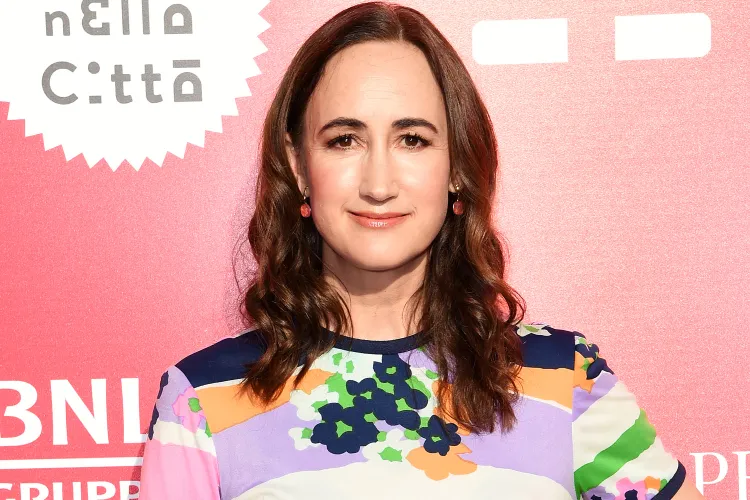
“I Meant What I Said”: Amanda Seyfried Doubles Down After Backlash Over Her Comment on Charlie Kirk’s Death
Amanda Seyfried is not stepping away from her words, no matter how much noise they’ve made. In a week where social media arguments rose and fell in waves, the acclaimed actress found herself in the middle of one of the year’s most polarizing cultural debates. It began quietly, with a brief Instagram comment that was quickly buried under thousands of responses — and then it exploded, reshaping the conversation around celebrity responsibility, political narratives, and the complicated emotions that emerge when controversial public figures pass away.

Shortly after the death of conservative activist Charlie Kirk, Seyfried — who is known for her outspoken support of progressive causes, mental-health advocacy, and a long career built on empathy-driven storytelling — wrote a brief remark under a post acknowledging his passing. Her words were blunt: she called him “hateful,” a descriptor she later said reflected her honest reaction to his public rhetoric. The internet reacted immediately and intensely. Some attacked her for speaking ill of the dead. Others applauded her for refusing to sanitize her views simply because someone had passed away. Many more, caught between grief and politics, felt torn.
What has brought the conversation back into the spotlight is Seyfried’s newest interview, where she spoke candidly about the aftermath of that moment. Not only did she stand by her original statement, she emphasized that she would “not f—ing apologize” for saying what she believed. For Seyfried, this was not an impulsive clap-back. It was a refusal to pretend that death automatically rewrites a lifetime of consequences, especially for public figures whose words shaped the national discourse in very real ways.
Her comments were direct but controlled — a reminder that she sees candor not as an act of aggression but as an ethical obligation. The actress acknowledged that she knew the criticism would come. Yet the interview revealed something deeper: the emotional exhaustion of a public figure who is constantly told to soften her voice while others are allowed to shout freely.
According to sources close to Seyfried, her reaction came from years of watching inflammatory commentary dominate political spaces, particularly comments directed at marginalized communities. Kirk, who rose to prominence as the founder of Turning Point USA, built a career shaping conservative student activism, giving him an enormous influence over the country’s younger political voices. Supporters praised him for energizing a movement; critics accused him of amplifying division and promoting harmful rhetoric. These debates didn’t disappear after his death — if anything, they became sharper, as people questioned how to speak honestly about a man whose legacy meant drastically different things to different Americans.
Seyfried’s stance, while controversial, points toward a broader cultural shift: the increasing unwillingness of public figures to perform neutrality. As she put it in her interview, she wasn’t trying to provoke, nor was she speaking from spite. Instead, she spoke from a place of conviction, saying that she refused to “rewrite history” for comfort.
Her refusal to apologize struck a chord beyond her own fanbase. Even those who disagreed with her phrasing couldn’t deny that her comments touched on a longstanding tension in American society — the expectation that death instantly demands reverence, and the simultaneous fear that honesty will be mistaken for cruelty. It created a situation where people were forced to confront uncomfortable questions: What do we owe the deceased? And what do we owe the living who were impacted by their words?

In the days following Kirk’s passing, memorial posts portrayed him as a passionate advocate for what he believed in. The outpouring of sorrow from his supporters reflected genuine mourning for a man who shaped conservative activism. But at the same time, those who experienced the other side of his political influence felt conflicted. Many remembered his commentary on immigration, LGBTQ+ issues, and cultural debates that often placed him at the center of political firestorms. They could mourn the man’s life while still critiquing the message he championed.
This is where Seyfried’s comment, however brief, carried its weight. It wasn’t an attack on the grieving; it was a reaction to the complicated legacy left behind. Her interview highlighted that complexity rather than trying to simplify it. She spoke about accountability not as a punishment but as an honest recognition of impact — something she believes public figures, regardless of their political alignment, should be prepared for.
She also touched on the emotional burden of backlash, saying that the online reaction reminded her how quickly digital spaces shift from discussion to hostility. Yet she appeared calm, even centered, in her explanation. For her, integrity mattered more than the noise. She insisted that while she understood people’s hurt, she would not pretend that her feelings were anything other than what they were.
Observers have noted that this moment reflects a broader trend among Hollywood personalities who are no longer hesitant to speak politically. The divide between entertainment and activism has been closing for years, and Seyfried — who has generally maintained a more private personal life — stepped into that space more boldly than usual. Her choice to do so now, amid a national climate still pulsing with polarization, shows the emotional weight she attaches to these issues.
The timing of her comment also played a role in the intensity surrounding it. Deaths of political figures often become instant battlegrounds — a mix of real grief, collective trauma, unresolved anger, and the human instinct to rewrite or sanitize legacies. Seyfried’s words disrupted that pattern. Whether one agreed or disagreed, her comment forced the public to acknowledge the full emotional reality of how people respond to controversial figures, even in moments of mourning.
The interview delved deeper into her worldview. She spoke softly but firmly about the importance of empathy while also drawing a line between empathy and silence. She expressed respect for those grieving but insisted that acknowledging harm is not an act of disrespect. To her, mourning becomes more meaningful when it’s accompanied by truth.
Friends of the actress say she has always been careful with her public statements, choosing authenticity over shock value. That makes her unwavering stance even more notable. It wasn’t a moment of anger; it was, in her words, a moment of clarity. And even now, she refuses to let outside pressure make her rewrite it.
Public reaction to her interview has again been mixed, but far more nuanced. Some applaud her courage. Others believe the timing of her words was insensitive. Many fall somewhere in between, navigating a complicated emotional space where grief, politics, and honesty collide. What almost everyone agrees on, though, is that Seyfried articulated something real — something many have felt but rarely say aloud.
The conversation also speaks to the evolving nature of public accountability. As society increasingly scrutinizes the power of rhetoric, especially in political spaces, more people are questioning whether silence in the face of harmful speech unintentionally supports it. Seyfried appears to be part of a generation of public figures who reject that silence. Her decision not to retract her statement echoes the broader sentiment that difficult truths do not vanish simply because acknowledging them makes people uncomfortable.
Charlie Kirk’s legacy, like that of many political activists, will continue to be debated. His supporters will remember him as a fearless advocate for their beliefs. His critics will point to the pain they associate with his commentary. Seyfried’s moment of candor sits somewhere in the middle of that landscape — a reminder that public figures, whether actresses or activists, are humans navigating emotional, moral, and political realities in real time.
The story does not end with her refusal to apologize. It opens a longer conversation about how society processes death, how public legacies are shaped, and how honesty sometimes becomes the most controversial stance of all. Seyfried may have spoken just one sentence in an Instagram comment, but the ripples of that moment continue to move outward, challenging the boundaries of politeness, responsibility, and truth.
In a time when every public statement becomes both magnified and dissected, Seyfried’s words — and her decision to stand by them — reinforce a simple but powerful idea: that people can mourn, remember, and reflect while still acknowledging the parts of a public legacy that hurt them. Her comment did not erase Kirk’s life. It highlighted the ways his influence was felt across the nation, for better or worse.
As the conversation continues, one thing remains clear: Seyfried’s voice will not be softened for comfort. And whether people agree with her or not, her honesty has reshaped the discussion in a way that feels deeply, undeniably human.