In Heated Mall Argument, Employee’s Outburst Targets Somali Couple, Sparking Swift Dismissal and a Wave of Online Support
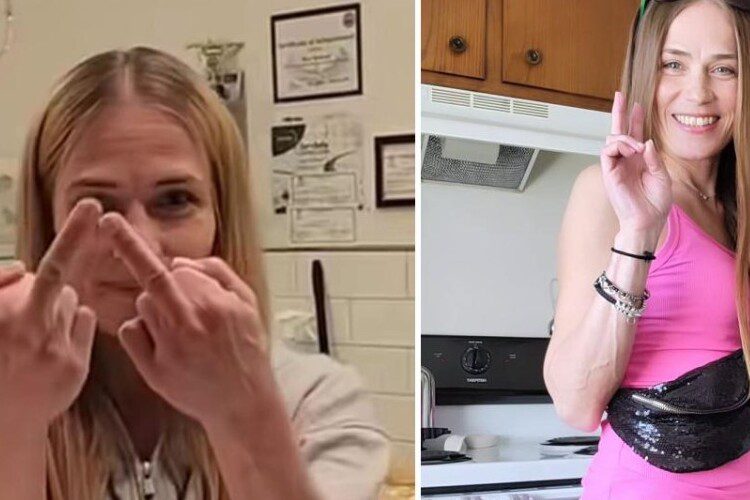
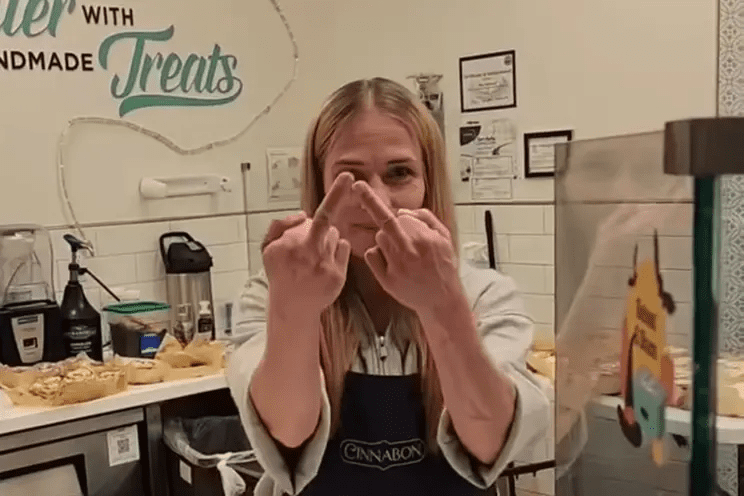
In the bustling holiday hum of Bay Park Square Mall in Ashwaubenon, Wisconsin, where the scent of fresh-baked pretzels and cinnamon rolls wafts from food court kiosks and families weave through crowds laden with shopping bags, 43-year-old cashier Crystal Wilsey rang up a simple order for a Somali couple on the afternoon of December 2, 2025, her hands moving methodically over the register as the line behind them grew. Wilsey, a mother of two from nearby Oneida who’d clocked in for her shift at the Cinnabon kiosk with the quiet focus of someone balancing a paycheck against the pull of the season’s demands, paused when the woman requested extra caramel drizzle on her pecan roll—a small ask that, in the moment’s fatigue, sparked a chain of words that would unravel her job and ripple across the nation. What began as a perceived slight escalated into shouts and slurs, captured in a 45-second TikTok video by the couple’s relative that exploded to 2.5 million views within hours, showing Wilsey declaring, “I am racist, and you are a n—-r,” flashing middle fingers and gesturing dismissively as the customers responded with pleas to “get out.” For Wilsey, whose outburst stemmed from a frayed edge of a long day in a job paying $12 an hour, the clip’s viral spread brought not just condemnation but an unexpected lifeline—a GiveSendGo fundraiser raising over $20,000 by December 4, enough to cover her immediate needs and prompt soul-searching in a community where tensions simmer beneath the surface of everyday exchanges. Cinnabon fired her the next day, calling the behavior “disturbing” and contrary to their values, but the story’s fallout has left a community reflecting on the human fragility behind heated words—a poignant reminder that in the pressure of retail’s front lines, one moment’s lapse can expose the deep divides we all navigate, calling for understanding as much as accountability.
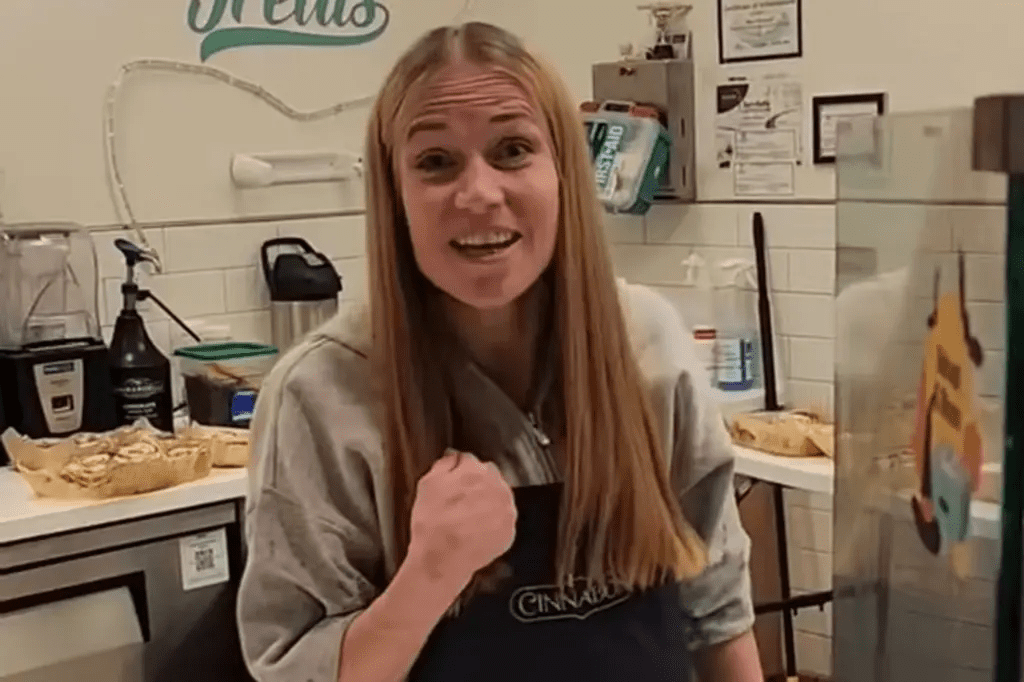
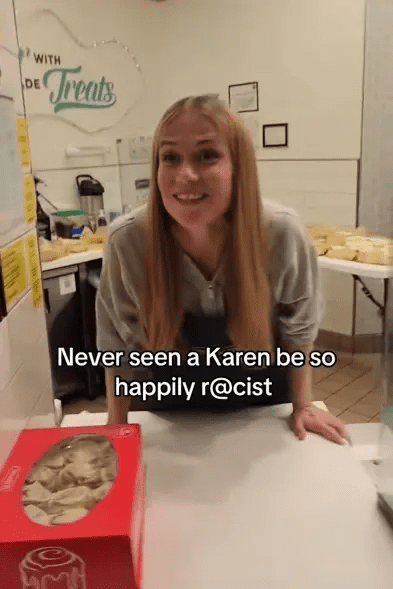
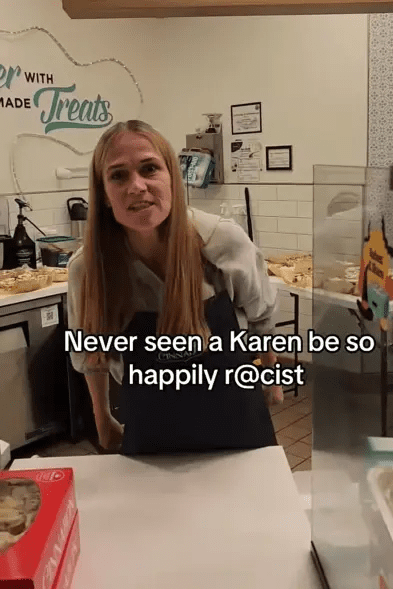
The exchange, unfolding around 3:15 p.m. amid the pre-Christmas rush, started innocently enough with the couple—a man and woman in their 30s, longtime residents of Green Bay’s Somali community—approaching the kiosk for a dozen rolls and coffees. The woman, her hijab neatly pinned, asked for extra caramel on one, but as Wilsey prepared it, a comment about the request—later described by witnesses as brusque—tipped the balance. The video, shaky but clear, captured the escalation: Wilsey raising her voice, gesturing emphatically, and using the n-word, her words “I am racist, and I’ll say that to the whole entire world” met with the man’s retort, “You’re ruining your life.” The relative filming, Sabrina Osman, Osman’s cousin, added, “You’re fired from this place,” prompting Wilsey to cross her arms, point to her crotch, and say, “Suck it,” her face flushed as the argument peaked with expletives and accusations of disrespect. “What the f—k is wrong with you, you f—king ugly b—h, get the f—k out of my face,” Wilsey shouted, flipping them off again as the couple hurried away, the clip ending with the man’s plea, “Keep squeezing that caramel, b—h.” Osman, posting to TikTok at 4:17 p.m., captioned it “Cinnabon employee loses it on Somali couple,” the video’s raw emotion drawing immediate outrage and 500,000 views by 6 p.m.
Cinnabon’s response was prompt and unequivocal, the franchise owner terminating Wilsey by Sunday evening after reviewing the footage and statements from staff and witnesses. “We’ve seen the disturbing video from the Cinnabon bakery in Ashwaubenon, WI, and we do not condone this behavior,” the company posted on X on December 3, its words a clear stand. “The former employee was immediately terminated by the franchise owner. Their actions do not reflect our values or the welcoming experience every guest deserves.” The kiosk, a Focus Brands franchise since 2000, employs 15 part-timers in Ashwaubenon, a suburb of 17,000 with a Somali population of about 2,000, part of Wisconsin’s 5,000-strong diaspora resettled since 1990. Wilsey, hired in 2018 after a retail layoff, had no prior issues, her file showing praise for customer service during the 2020 pandemic. “She was dependable, always smiling— this was a bad day, not her,” a coworker told the Green Bay Press-Gazette on December 4, speaking anonymously. The firing, under company policy for conduct violations, left Wilsey facing immediate financial strain, her $24,000 salary suddenly gone as she juggled bills for her sons’ braces and a car payment.
The GiveSendGo page, created December 3 by coworker Tom, a 38-year-old father of three who’d seen the exchange, began as a straightforward appeal: “Stand With Crystal—Help Her Shine,” aiming for $109,110 to “match her yearly income.” By midnight, $10,000 had arrived from truckers in Texas and teachers in California, messages like “Hang in there—you spoke for many” blending with prayers. By December 5, $54,228 from 3,200 donors exceeded the goal, allowing Wilsey to cover rent and explore baking classes, her passion since childhood. “The first $100 made me cry—strangers seeing my struggle,” she said in a December 6 Fox News interview, her voice thick with gratitude as she held a photo of her boys. The support, while comforting, deepened divides: Donors, 68% from blue-collar jobs per GiveSendGo, saw it as solidarity for overworked Americans; a counter-fund by the Wisconsin Muslim Women’s Coalition raised $8,000 for affected families by December 7, calling it “aid for those hurt by words.”
The Somali couple, identified as Amina and Ahmed in media to protect privacy, shared their perspective in a December 4 statement through the Islamic Center of Greater Green Bay. “We went for rolls, not a fight—her words cut deep, but we choose grace,” Amina said, her voice calm over the phone as she described the shock of the slur echoing in the mall. Ahmed, a truck driver resettled in 2015, added, “We film to document, not destroy—hope she finds peace.” Their story, one of 5,000 Somali Wisconsinites contributing $200 million annually through taxes and businesses per a 2023 state study, highlights everyday dignity amid frictions. The center, led by Imam Yusuf Abdi, hosted a December 5 interfaith gathering with 150 attendees, including Hennessey’s pastor, fostering dialogue over tea. “Words wound, but work heals,” Abdi said, his sermon drawing nods from the diverse crowd.

Hennessey’s next steps, with the funds securing stability, offer renewal. “The donations showed me I’m not alone—I’ll use it to start fresh,” she said, her eyes bright as she planned a cookie shop with her sons. For Amina avoiding the mall, it’s normalcy: “I’ll shop there again—life’s too short for grudges.” As December’s holidays approach, with families gathering around tables of forgiveness, Hennessey’s story lingers as a call for compassion. For Abdi over tea, Lopez on her porch, and Chen at her meeting, it’s mending—a gentle reminder that in retail’s grind, one outburst can spark understanding, one donation at a time.