Chairman’s Bold Trump Salute from Japan Sparks Global Buzz
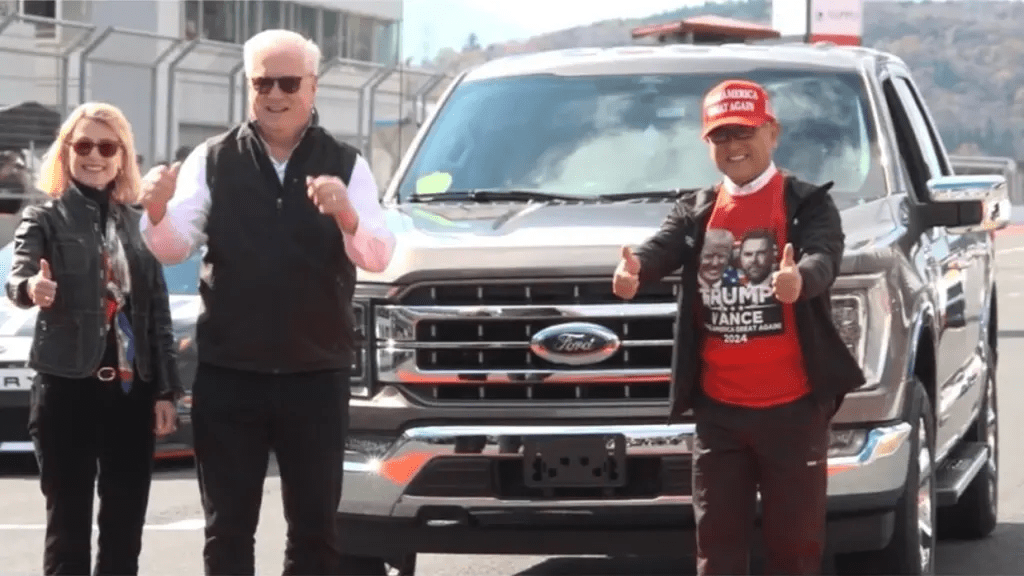
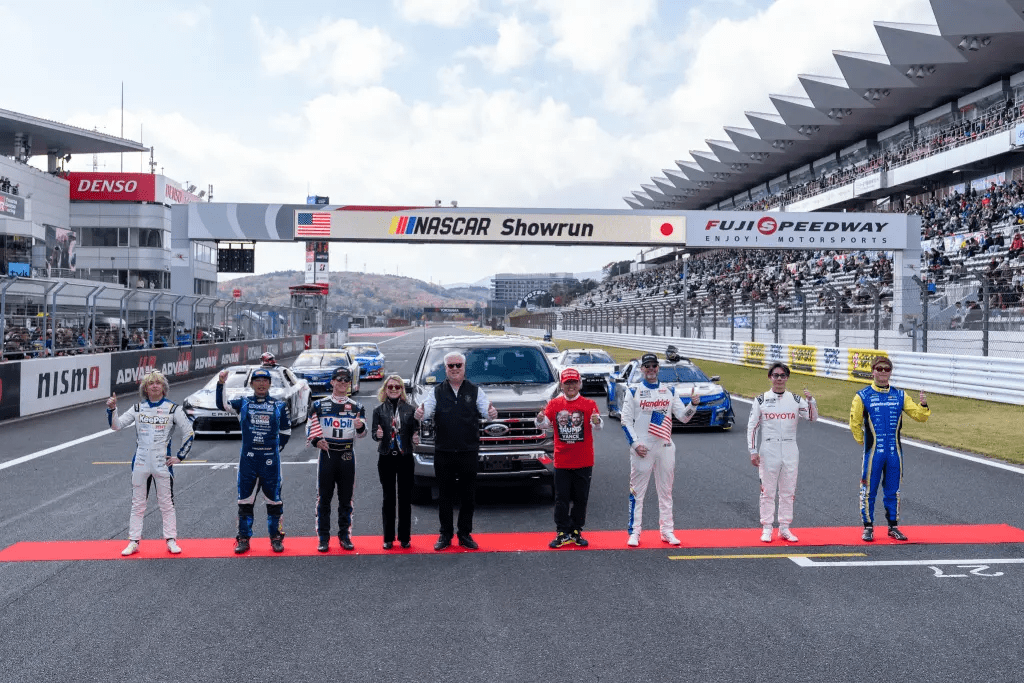
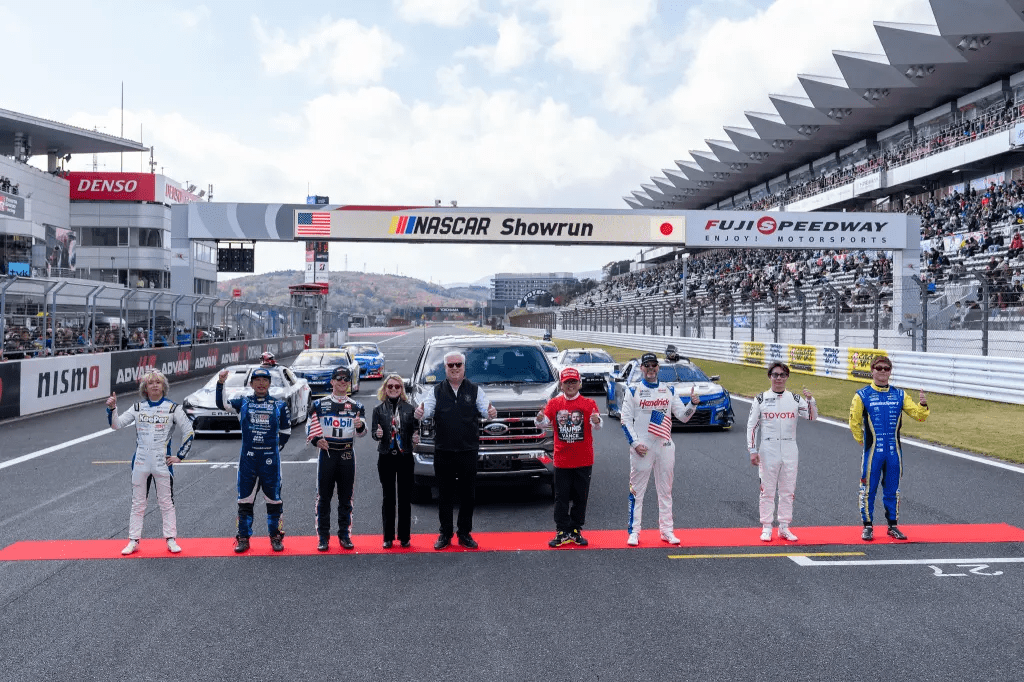
Amid the thunderous roar of engines and the acrid tang of burning rubber at Fuji Speedway, where the Japanese countryside rolls out like a green canvas under a crisp November sky, Akio Toyoda stepped into the spotlight not as the scion of an automotive empire, but as a man wearing his heart—and his politics—boldly on his sleeve. It was November 16, 2025, the final lap of Japan’s ENEOS Super Taikyu Series, but the real race stealing the show was a star-spangled NASCAR extravaganza hosted by Toyoda himself, the 69-year-old chairman of Toyota Motor Corporation whose family name has powered the world since his grandfather Kiichiro dreamed up the first Corolla in a postwar shed. There, grinning ear-to-ear in a crimson “Make America Great Again” hat perched atop his silver hair and a “Trump-Vance 2024” T-shirt stretched across his frame, Toyoda led a convoy of six gleaming NASCAR beasts—piloted by legends like Jimmie Johnson and Kamui Kobayashi—around the track in a Ford F-150 that screamed American muscle. Flanked by U.S. Ambassador George Glass in the passenger seat, Toyoda wasn’t just celebrating speed; he was saluting strength, a generational ally to the United States whose visible nod to President Donald J. Trump felt like a heartfelt high-five across the Pacific, a testament to bonds forged in factories and fairways that run deeper than any trade spat.
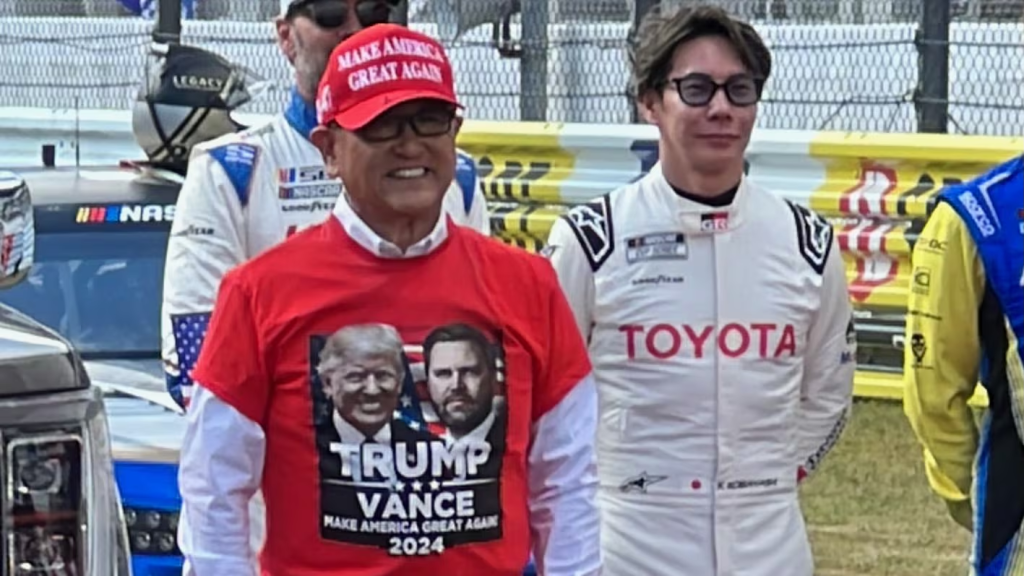
Toyoda’s MAGA moment didn’t emerge from thin air; it was the crescendo of a symphony he’s conducted for years, blending Japanese precision with unshakeable American optimism. Born in 1956 to the legacy of Toyota’s founding family, Akio wasn’t groomed solely for spreadsheets—he raced cars, won rallies, and infused the company with a passion for the driver’s thrill that turned Toyota from a scrappy upstart into the world’s top automaker by volume. His tenure as president from 2009 to 2023 weathered tsunamis and recalls, but it was his personal touch—visiting U.S. plants in a Prius, schmoozing at Detroit auto shows—that endeared him to American workers. Fast-forward to Trump’s first term, and Toyoda was there, inks deals amid tariff tempests, committing $10 billion to U.S. shores that created 20,000 jobs in states like Kentucky and Texas. Now, in 2025, with Trump back at the helm and trade winds shifting, Toyoda’s Fuji flourish—hat, shirt, and all—signals not pandering, but partnership, a chairman who sees in the president a kindred spirit: bold, unapologetic, laser-focused on making manufacturing roar again. “Japan is a generational, incredible ally of the United States,” the post capturing his ensemble proclaimed, and in that red cap, Toyoda embodied it, a quiet revolutionary waving the flag for friends across the sea.
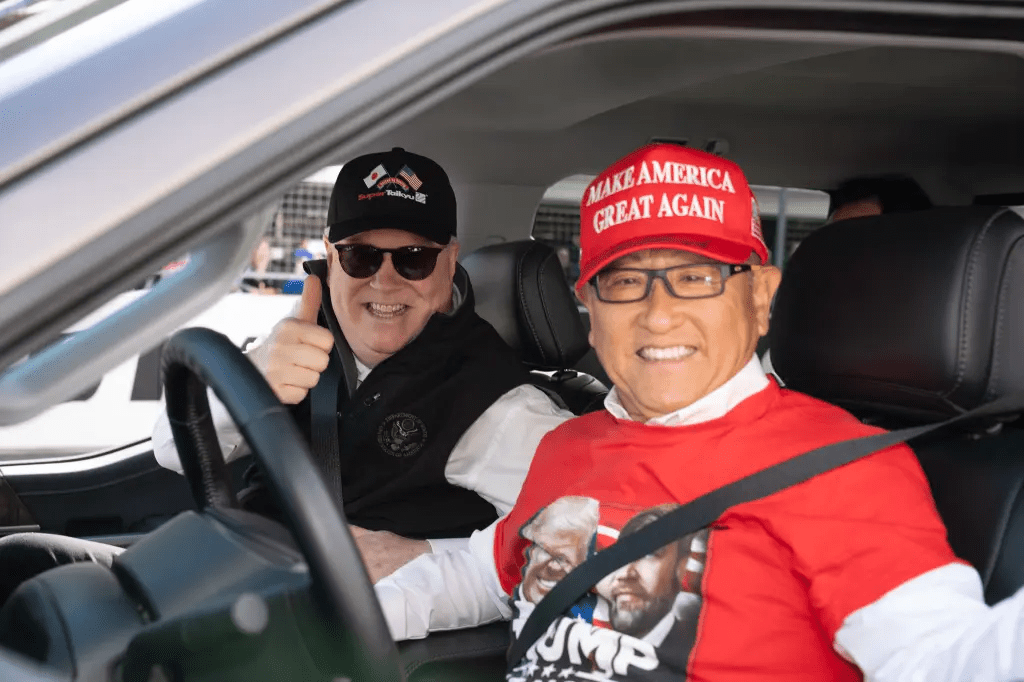
Picture the scene at Fuji: the track’s banking curves alive with the growl of V8s shipped straight from Charlotte, American flags snapping in the breeze alongside rising suns, barbecues sizzling with stateside ribs for a crowd of 5,000 gearheads who came for the laps but stayed for the lore. Toyoda, behind the wheel of that F-150—borrowed from Ford, a rival turned running mate in the global game—piloted the pack with Glass beside him, the ambassador tweeting live: “A day of spectacular NASCAR racing at Fuji Speedway with Toyota Chairman Akio Toyoda. Looking forward to celebrating the culture of U.S. motorsports again next year.” It was more than demo laps; it was diplomacy on wheels, a cultural crossover that bridged Tokyo’s tech-savvy streets with Nashville’s neon nights. Toyoda, ever the enthusiast, didn’t just host—he hopped in, his laughter booming over the radio as Kobayashi, Toyota’s own F1 alum, chased in a Camry-bodied stocker. The event, part of the Automobile Business & Culture Association of Japan’s push to infuse Yankee vroom into Japanese veins, drew stars like John Hunter Nemechek, but Toyoda’s outfit stole the thunder: that MAGA hat, a scarlet beacon against the track’s grays, paired with the T-shirt’s bold print, turning heads from pit row to press box. “I’m not here to argue whether tariffs are good or bad,” Toyoda said in a pre-event chat, his English laced with warmth. “Every national leader wants to protect their own auto industry. We are exploring ways to make tariffs a winner for everyone. The people we want most to be winners are our customers.”
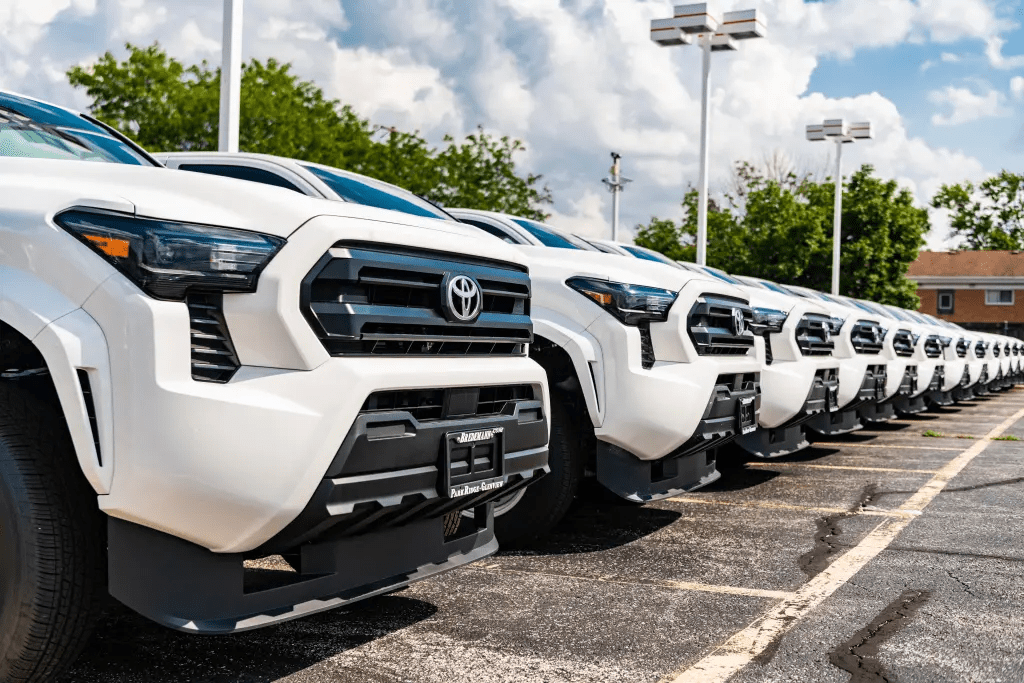
This wasn’t Toyoda’s first rodeo with American flair; his love affair with the U.S. runs as deep as the Detroit River, forged in the fires of postwar reinvention when his grandfather bet the farm on Yankee know-how. Toyota’s U.S. footprint—14 plants employing 70,000, churning out Camrys and Corollas that power American commutes—stems from that grit, a saga of $30 billion invested since 1988 that outpaces even Honda’s heartland hug. Under Trump 1.0, amid steel duties and auto levies that rattled Tokyo, Toyoda didn’t flinch; he doubled down, announcing expansions in Indiana and Mississippi that added 1,500 jobs and shielded against the 25% import hit. Now, in 2025, with Trump’s second act unleashing a tariff toolkit—15% on Japanese autos down from 27.5%, but paired with incentives for domestic builds—Toyoda’s MAGA garb feels like a savvy signal, a chairman betting big on the man who turned trade wars into triumphs. Just days later, on November 18, Toyota unveiled a $912 million infusion across five Southern plants—$370 million for hybrids in Kentucky, $200 million for batteries in North Carolina—part of a $10 billion pledge by 2030 that echoes the first-term windfall. “Toyota’s philosophy is to build where we sell,” said Kevin Voelkel, senior VP of manufacturing, in a Liberty groundbreaking speech, his words a nod to the 252 new jobs sprouting in soil tilled by Trump’s tiller.
The emotional pull here tugs at the heartstrings of every blue-collar dreamer who’s ever revved a V6 on a Friday night drive—from the welder in Georgetown, Kentucky, whose Toyota paycheck funds his daughter’s braces, to the retiree in Huntsville, Alabama, reminiscing over a ’95 Tacoma that outlasted two marriages. Toyoda’s Trump salute isn’t corporate cosplay; it’s camaraderie, a recognition that alliances aren’t abstract—they’re the handshakes at supplier fairs, the shared beers after shift whistles. Japan, that island powerhouse whose post-WWII miracle mirrored America’s own, has been a bedrock buddy: $68 billion in U.S. investments last year alone, tech transfers that turbocharged EVs, military pacts under Trump’s Quad that checked China’s sea grabs. Toyoda, grandson of the founder who sketched the AA sedan on a napkin, embodies that bond—a racer at heart who pilots his own GR Supra on weekends, his MAGA hat a hat-tip to the drag-strip daring that defines both nations. “We need more allies like Japan!” the viral post cheered, and in Toyoda’s grin, you see it: two giants gearing up together, engines humming in harmony against headwinds from Beijing’s belt-and-road bullying.
Of course, not everyone’s shifting into high gear without a glance in the rearview. Critics in Tokyo’s chattering classes—those salarymen scrolling Nikkei over sake—mutter of pandering, a chairman kowtowing to tariffs that could clip 2% off Toyota’s profits if hiked higher. Reddit threads buzz with “WTF, Akio?” memes, one user quipping, “Next he’ll drive a Cybertruck to the boardroom.” Fair skepticism; trade’s a tango, and Trump’s tariffs—slashed to 15% for autos but poised for tweaks—walk a tightrope between protection and provocation. Yet Toyoda’s no novice; his 2023 pivot to hybrids amid EV hype saved Toyota $20 billion in battery bets, proving his nose for nuance. Balanced against the barbs, the benefits beam: that $912 million splash creates assembly lines where American hands bolt frames for families worldwide, hybrids rolling off in Huntsville that cut emissions 40% over gas guzzlers. Trump’s touch? Golden—his first-term USMCA locked in wage floors for Mexican plants, now echoed in 2025 incentives that lure $50 billion in foreign direct investment, Toyota leading the pack.

As the Fuji checkered flag waved that Sunday, Toyoda peeled out in his F-150, the crowd’s cheers a chorus of cross-cultural kinship. For Jimmie Johnson, seven-time Cup champ who demo’d a Mustang that day, it was “pure adrenaline,” a bridge from Bristol to Fuji that Toyoda built with his own hands. For Glass, the ambassador whose tweet lit up 2 million timelines, it’s diplomacy democratized—racing as rapport, hats as handshakes. And for Trump, fielding kudos from Mar-a-Lago, it’s vindication: a president whose “America First” isn’t isolation, but invitation, drawing allies like Toyoda into the fold with the magnetism of a man who turns tariffs into treasures. Families in Buffalo, where Toyota’s Georgetown plant employs 8,000, feel it most—the steady paychecks, the community centers funded by corporate giving, the pride in building beasts that conquer commutes. Toyoda’s MAGA moment? A masterstroke, a chairman choosing camaraderie over caution, proving that in the grand garage of global trade, true partners rev engines together, leaving rivals in the dust.
This Fuji flourish isn’t finale; it’s fast-forward, with Toyota’s $10 billion horizon hazy but hopeful—plants in Indiana humming hybrids by 2027, battery breakthroughs in Greensboro that green the grid. Toyoda, back at Nagoya HQ, sketches strategies with the same fervor his grandfather poured into prototypes, his MAGA hat tucked in a drawer like a lucky charm. For the American worker clocking overtime on a Tundra line, it’s assurance: allies like Japan aren’t fair-weather friends—they’re family, fueled by the forward march Trump champions. As November’s leaves turn in Kentucky hollows, the roar from Fuji echoes—a symphony of speed and solidarity, where a red hat rallies a red, white, and blue revival, one V8 victory at a time.