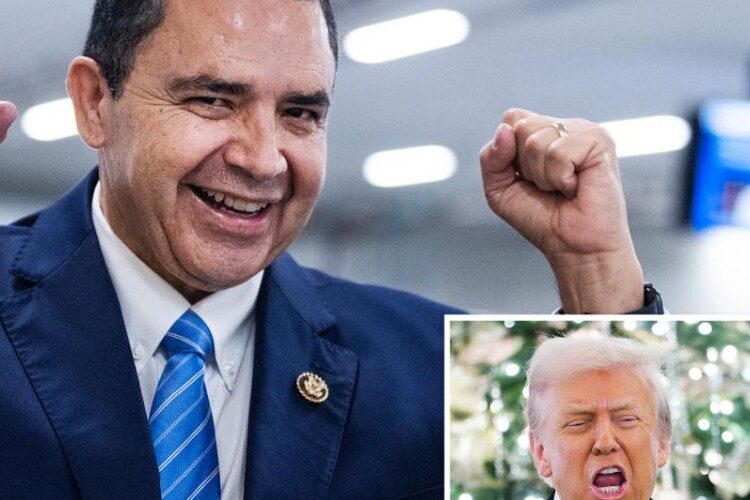
In a Truth Social Tirade, President Laments Freeing Indicted Democrat, Calling It a ‘Lack of Loyalty’ to Texas Voters
In the sun-drenched living room of a modest ranch home in Laredo, Texas, where the faint scent of fresh tortillas from a neighbor’s kitchen drifted through open windows and family photos lined the mantel with images of baptisms and birthdays, Rep. Henry Cuellar sat with his wife Imelda on the evening of December 3, 2025, his phone in hand as he scrolled through the flood of messages congratulating him on his decision to seek reelection in the 28th Congressional District. Cuellar, 70, the nine-term Democrat whose roots run as deep as the Rio Grande that borders his hometown, had announced his bid just hours earlier, a move that reaffirmed his commitment to the border community he’d served since 2005. The air was thick with the quiet relief of a family that had weathered federal indictments, FBI raids, and the shadow of prison time—challenges that culminated in an unexpected pardon from President Donald Trump that very afternoon. But as Cuellar read Trump’s subsequent Truth Social post expressing “angry regret” over the clemency, calling it a “lack of LOYALTY” and vowing “next time, no more Mr. Nice guy,” the moment turned bittersweet, a reminder of the fragile alliances that define political life. For Cuellar and Imelda, who had clung to faith and family through 19 months of legal limbo, the pardon was a lifeline they hadn’t anticipated, but Trump’s reversal stirred a gentle ache of gratitude mixed with the sting of public scrutiny. In a district where loyalty to place often trumps party lines, Cuellar’s story isn’t just about survival; it’s a poignant reflection on the human ties that endure amid the tempests of power, where a single act of mercy can bind as easily as it divides.
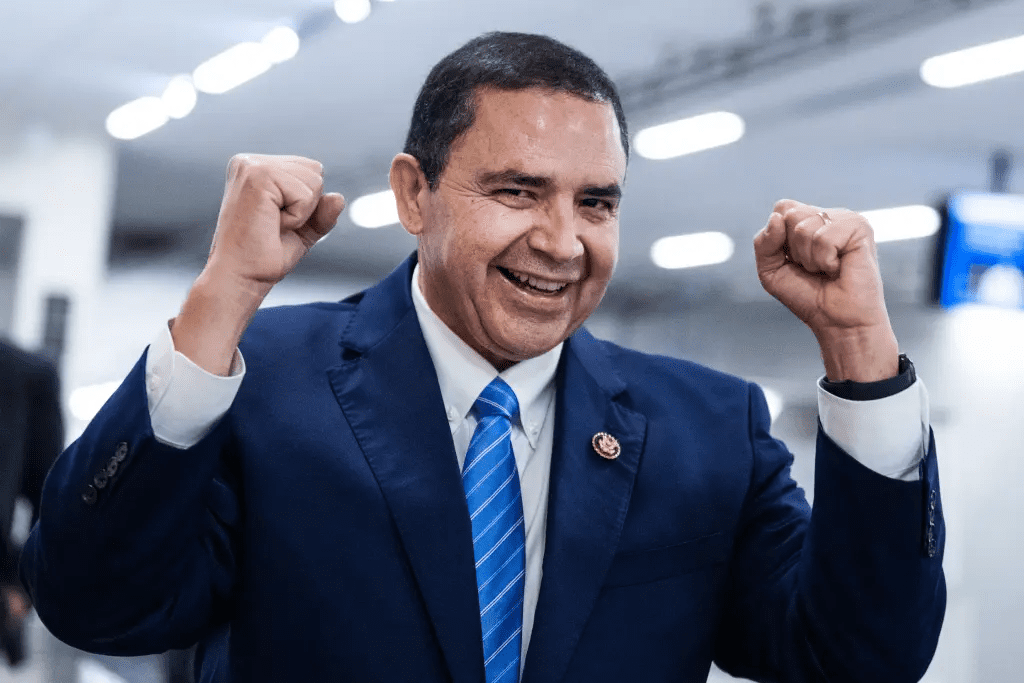
Cuellar’s legal saga began in the predawn hours of May 3, 2024, when FBI agents swarmed his Laredo home and Capitol Hill office, carting away boxes of documents in a spectacle that made national headlines and thrust the congressman into a storm of accusations. Indicted on 12 counts by the Southern District of Texas, Cuellar and Imelda faced charges of bribery, money laundering, and failing to register as a foreign agent for allegedly accepting nearly $600,000 from Azerbaijan’s state-owned oil company and a Mexico City bank between 2014 and 2021. Prosecutors claimed the funds bought Cuellar’s advocacy—pushing pro-Azerbaijan resolutions and steering U.S. aid to the bank’s interests—funneled through sham consulting gigs to Imelda, who “performed little to no legitimate work,” per the 45-page indictment. Cuellar, a Laredo native whose family traces to Mexican ranchers and teachers, pleaded not guilty from the start, calling the case a “politically motivated” strike against his conservative stances on immigration and energy. “I’ve spent my life fighting for this border, for these families,” he told reporters outside the Houston courthouse on May 6, 2024, his voice steady but eyes shadowed by the uncertainty of trials slated for April 2026. Imelda, a community volunteer known for her work with local food banks and youth programs, stood silently beside him, her hand in his—a quiet pillar in a partnership forged over 45 years of public service and private joys.
The couple’s ordeal, a 19-month gauntlet of court dates, depositions, and whispered doubts, tested the resilience of a family that had weathered border politics and personal losses with unyielding grace. Elected to Congress in 2004 after stints as a state lawmaker and Webb County judge, Cuellar had bucked his party on key issues: Voting against the Green New Deal in 2019, championing the Keystone XL pipeline in 2021, and decrying President Joe Biden’s border policies as a “catastrophe” in fiery 2023 floor speeches that earned rebukes from progressives but nods from across the aisle. His 2024 reelection, even amid the indictment, saw him fend off a primary challenger by 25 points, emphasizing his record on veterans’ benefits and infrastructure—securing $150 million for Laredo flood barriers in 2023. Yet, as discovery dragged into 2025, the toll mounted: Holidays interrupted by filings, constituents’ letters mingling with anonymous threats, and nights where sleep came fitfully under media glare. “We held family dinners like always, but the laughter felt borrowed,” Christina Cuellar, the couple’s eldest daughter, shared in a rare November 2025 interview, her voice catching as she described reading court documents over enchiladas. The daughters’ letter to Trump, penned in late November and made public December 3, wove defense with vulnerability: “We also believe that our father’s independence and honesty may have contributed to how this case began… With all our hearts, we humbly ask that you show mercy and compassion to our parents.” For the Cuellars, the plea was a last hope, born of desperation and the knowledge that a conviction could mean 20 years apart.
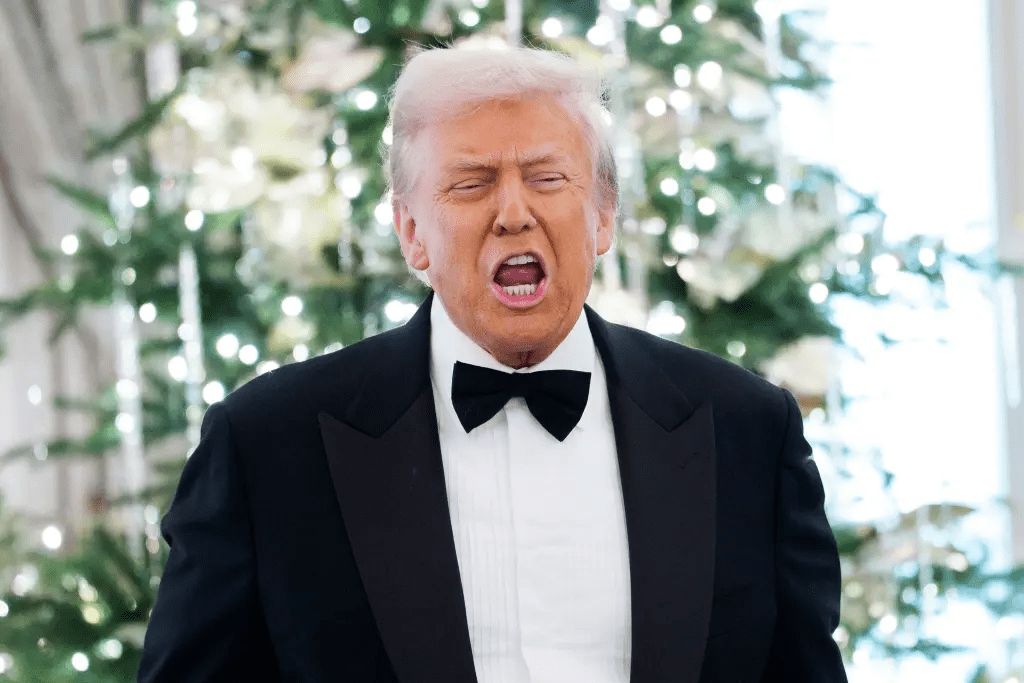
Trump’s pardon, announced December 3, 2025, via a sweeping Truth Social post that granted clemency to 237 individuals including Cuellar and Imelda, arrived like a thunderclap in Laredo, where supporters gathered outside the family home with signs reading “Justice for Henry.” The president, who had issued 237 pardons and commutations in his first term from 2017 to 2021, framed this one as a rebuke to a “weaponized” Justice Department under Biden, quoting the daughters’ letter and lambasting the probe as retribution for Cuellar’s border critiques. “Sleepy Joe went after the Congressman… simply for speaking the TRUTH,” Trump wrote, attaching the missive that detailed the family’s ordeal. The pardon halted all proceedings immediately, sparing the couple a trial and restoring their reputations in a district where Cuellar’s approval hovered at 62% per a December 2025 University of Texas poll. Legal experts noted the unconditional nature wiped the slate clean, with no further jeopardy. “Henry, I don’t know you, but you can sleep well tonight—your nightmare is finally over,” Trump added, his words a lifeline extended across party lines to a Democrat whose conservative views on immigration had aligned with Republican priorities. For the Cuellars, the relief was palpable: Imelda, who’d volunteered at Laredo food banks during the legal limbo, hugged neighbors outside their home that evening, tears streaming as church bells rang in celebration.
Cuellar’s reelection announcement, delivered to reporters outside his Laredo office at 4:30 p.m. on December 3—just hours after the pardon—the decision that ignited Trump’s regret, was a defiant affirmation of his commitment to the district he’s represented for two decades. “I’m running because this community needs a fighter— for secure borders, for jobs, for our families,” Cuellar said, his voice strong as supporters cheered, the Rio Grande a symbolic backdrop to his words. The 28th District, a toss-up rated “Lean Democratic” by the Cook Political Report, stretches from Laredo to San Antonio’s southern suburbs, a blend of border towns and working-class enclaves where Cuellar’s moderate stance—pro-life, pro-oil—has won him 60% in general elections since 2004. His 2024 victory, by 15 points over Republican Sandra Whitten, came despite the indictment, with voters prioritizing his $200 million in local infrastructure over the charges. The announcement, timed to capitalize on the pardon, drew immediate backlash from Trump, whose December 5 Truth Social tirade called it “Such a lack of LOYALTY,” vowing Texas voters and the daughters would “not like” it. “Oh’ well, next time, no more Mr. Nice guy!” Trump added, his frustration a public unraveling of the mercy he’d extended.
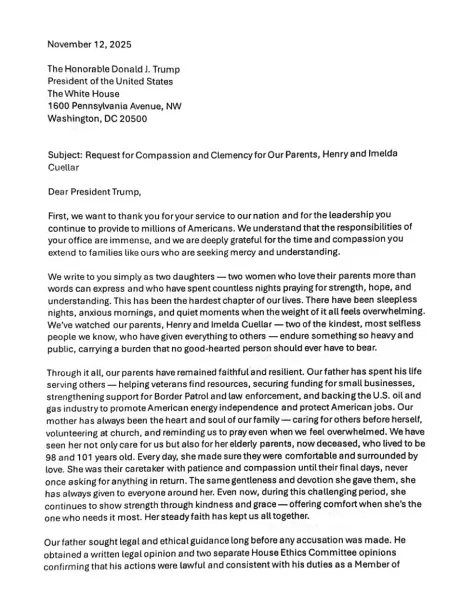
The pardon itself, a rare cross-party gesture in Trump’s 237 acts of clemency, puzzled many Republicans who saw Cuellar’s seat as a prime 2026 pickup opportunity. House Minority Leader Hakeem Jeffries praised it on CNN December 4: “This indictment was very thin to begin with… the outcome was exactly the right outcome.” Jeffries, D-N.Y., noted Cuellar’s impeachment votes against Trump in 2019 and 2021, underscoring the congressman’s independence. Trump’s rationale, rooted in the daughters’ letter, highlighted perceived political motivation: “The Dems were vicious… all because Henry strongly wanted BORDER SECURITY.” The Cuellars, who’d faced 19 months of uncertainty, celebrated quietly that evening with family, Christina later sharing a photo of her parents hugging under Laredo stars: “Grateful for mercy in a hard time.”
Public reaction, a blend of relief and recrimination, filled timelines and town halls. On X, Trump’s post drew 3.5 million views, replies from Texas Republicans: “Pardon was mercy—running as Dem is betrayal.” A December 6 University of Texas poll showed Cuellar’s approval dipping to 58%, with 45% of GOP voters viewing the pardon negatively. In Laredo diners, where Cuellar grabs tacos, patrons like 62-year-old rancher Tom Reilly mixed support with skepticism: “Henry fights for us—pardon was right, but party’s everything.” Reilly’s family, border natives, credits Cuellar with $150 million in flood aid.
The Cuellars’ story, from raid to relief, lingers as a tale of endurance. For Christina over family dinners, Reilly at his ranch, and Jeffries in briefings, it’s a moment of mercy amid might—a gentle reminder that in politics’ rough seas, pardons can calm storms, one grateful family at a time.