Amid Son’s Hint at Walking Away, President’s Frustration Underscores High Stakes in Ukraine Talks
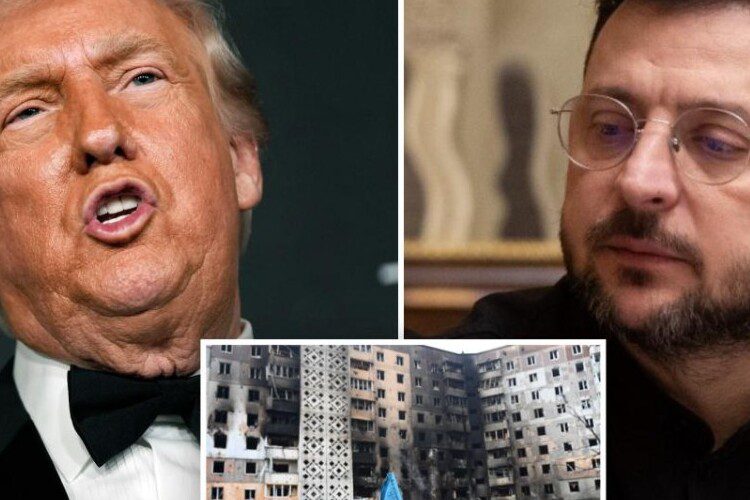
In the gilded hush of the Kennedy Center’s Eisenhower Theater, where the soft applause of a star-studded crowd provided a velvet backdrop to the 48th Annual Kennedy Center Honors on the evening of December 8, 2025, President Donald Trump paused amid presenting gold medals to cultural icons like Sylvester Stallone and Gloria Gaynor, his expression shifting from the warmth of celebration to the measured disappointment of a dealmaker facing a stalled negotiation. “I have to say that I’m a little bit disappointed that President Zelensky hasn’t yet read the proposal, that was as of a few hours ago,” Trump told reporters in the lobby, his voice carrying the familiar cadence of frustration tempered by optimism, a tone honed from decades of boardroom battles and White House briefings. The comment, delivered casually between handshakes with attendees like former President Barack Obama and Lady Gaga, came on the heels of a reworked U.S.-brokered peace plan for Ukraine that Russia had rejected the previous month, a 19-point framework aimed at halting the conflict’s bloodshed now entering its fourth year. For Trump, who has positioned himself as the architect of potential resolution since his January 2025 inauguration, the delay felt personal—a leader he admires for marketing savvy but questions for readiness, a dynamic that underscores the delicate dance of diplomacy where patience meets the press of public expectation. As the gala’s spotlight shifted to tributes for George Strait and Kiss, Trump’s words lingered like an unplayed note, a gentle reminder that in the symphony of global affairs, one unread proposal can echo louder than applause, touching the lives of millions waiting for peace’s overture.

The peace plan, hashed out in a series of Florida meetings last month between U.S. negotiators led by Trump’s son-in-law Jared Kushner and special envoy Steve Witkoff with Ukrainian counterparts Andriy Hnatov and Rustem Umerov, secretary of the National Security and Defense Council, represented a significant evolution from an earlier 28-point draft that had drawn fire from pro-Ukraine lawmakers in Congress. That initial version, circulated in November, called for Kyiv to cede the entire Donbas region—a territory Russia has failed to fully control for over a decade, even before its 2022 full-scale invasion—and commit to never joining NATO, while shrinking its military from roughly 900,000 to 600,000 personnel and offering amnesty to all war participants, including those accused of atrocities. Russia was asked for few concessions in return, prompting apoplexy from Capitol Hill figures like Sen. Lindsey Graham, R-S.C., who labeled it a “surrender disguised as peace” in a November 15 floor speech. The reworked 19-point framework, details of which remain partially classified, softens some demands—Ukraine retains parts of Donbas under a demilitarized zone, and NATO aspirations are deferred rather than abandoned—but still requires significant territorial and military compromises, with Putin rejecting it outright on November 28 as “unacceptable capitulation.” Zelensky, in a Saturday post on X, commended the “very focused, constructive discussion,” stressing work on “key points that could ensure an end to the bloodshed and eliminate the threat of a new Russian full-scale invasion.” His words, viewed 1.2 million times, carried the weary resolve of a leader whose nation has lost over 100,000 soldiers since February 2022, per Ukrainian Defense Ministry estimates.
Trump’s disappointment, voiced amid the honors’ glamour, betrayed a frustration with Zelensky’s pace that has simmered since their first post-inauguration call in February 2025, when the president pressed for concessions to jumpstart talks. “His people love it, but he hasn’t. Russia’s fine with it,” Trump said, his optimism for Moscow’s receptivity a nod to backchannel discussions with Foreign Minister Sergey Lavrov, who on December 1 called the plan “a basis for dialogue” in a TASS interview. The U.S. role, amplified by Trump’s personal diplomacy—including a September 2025 summit in Riyadh where he hosted Zelensky and Putin separately—has positioned America as mediator, with Kushner shuttling proposals amid a war that has displaced 6 million Ukrainians and cost $500 billion in damages, per World Bank data. Zelensky’s London trip on December 9, huddling with European leaders like UK Prime Minister Keir Starmer and French President Emmanuel Macron, aimed to rally allies for leverage, his team emphasizing “no surrender” while acknowledging the plan’s “realistic elements.” For Zelensky, 47, whose wartime leadership has boosted his approval to 75% per a December 2025 Kyiv International Institute of Sociology poll, the unread proposal reflects caution: Past Russian promises, like the 2014 Minsk accords, collapsed into renewed fighting, leaving 14,000 dead before 2022.

Trump’s son, Donald Trump Jr., added a layer of familial candor to the president’s exasperation during a December 7 appearance at the Doha Forum, a gathering of global leaders in Qatar where he hinted at a potential U.S. pullback. “I think he may,” Don Jr. said when asked if his father would walk away from Ukraine, his words measured but pointed as he praised Trump’s unpredictability. “What’s good about my father, and what’s unique about my father, is you don’t know what he’s going to do. The fact that he’s not predictable … forces everyone to actually deal in an intellectually honest capacity.” Don Jr., 47, a business executive and podcast host whose influence in his father’s circle has grown since 2024, took swipes at Zelensky’s portrayal as a “borderline deity” in Western media, especially on the left, where “he could do no wrong; he was beyond reproach.” “We want peace. We want to stop the death,” he added, his tone a blend of frustration and empathy for the war’s toll, which has seen 500,000 Russian casualties per U.S. intelligence estimates. Don Jr.’s comments, viewed 1.8 million times on X clips, echoed his father’s wavering: In September 2025, Trump called Putin a “paper tiger” and suggested Ukraine could reclaim territory, but by November, he leaned toward Moscow’s desire to “end the war.”
The U.S. public, weary of the conflict’s cost—$175 billion in aid since 2022 per the Congressional Research Service—shows shifting sentiments, with a December 2025 Reagan National Defense Survey finding 62% support for Ukraine up from 55% in October, 64% backing weapons shipments, and 70% doubting Russia’s reliability in deals. The plan’s concessions, including a demilitarized Donbas and military caps, have divided Capitol Hill: Pro-Ukraine Republicans like Sen. Lindsey Graham decried the draft as “surrender” in a November 20 Senate speech, while Democrats like Sen. Jeanne Shaheen praised Zelensky’s “principled stand” in a December 4 Foreign Relations Committee hearing. Shaheen, D-N.H., emphasized the need for “ironclad guarantees” against Russian revanchism, her words a call for the plan’s evolution amid Zelensky’s London talks. The Ukrainian president, trekking to the U.K. capital on December 9 for meetings with Starmer and Macron, stressed in a pre-trip X post the importance of “eliminating the risk of Russia failing to honor its promises, as has happened repeatedly in the past.” Zelensky’s team, including Umerov, has reworked elements like amnesty scope to exclude war crimes, per a December 6 Reuters report, aiming for a framework that preserves sovereignty while pausing hostilities.

Trump’s disappointment, voiced amid the honors’ glamour, betrayed a frustration with Zelensky’s pace that has simmered since their first post-inauguration call in February 2025, when the president pressed for concessions to jumpstart talks. “His people love it, but he hasn’t. Russia’s fine with it,” Trump said, his optimism for Moscow’s receptivity a nod to backchannel discussions with Foreign Minister Sergey Lavrov, who on December 1 called the plan “a basis for dialogue” in a TASS interview. The U.S. role, amplified by Trump’s personal diplomacy—including a September 2025 summit in Riyadh where he hosted Zelensky and Putin separately—has positioned America as mediator, with Kushner shuttling proposals amid a war that has displaced 6 million Ukrainians and cost $500 billion in damages, per World Bank data. Zelensky’s London trip on December 9, huddling with European leaders like UK Prime Minister Keir Starmer and French President Emmanuel Macron, aimed to rally allies for leverage, his team emphasizing “no surrender” while acknowledging the plan’s “realistic elements.” For Zelensky, 47, whose wartime leadership has boosted his approval to 75% per a December 2025 Kyiv International Institute of Sociology poll, the unread proposal reflects caution: Past Russian promises, like the 2014 Minsk accords, collapsed into renewed fighting, leaving 14,000 dead before 2022.
The human cost of the delay weighs heaviest on families like that of 29-year-old Kyiv teacher Olena Kovalenko, who lost her husband in a 2023 Donbas shelling and now raises their 5-year-old son amid nightly blackouts. Kovalenko, tuning into Zelensky’s London remarks from her basement apartment, felt a mix of hope and heartache. “Every day without peace is another scar—read the plan, please, for kids like mine,” she said in a December 10 video call, her voice soft as she held her son’s drawing of a blue-and-yellow flag. Kovalenko’s story, one of 10 million displaced Ukrainians per UN data, underscores the war’s toll—500,000 casualties since 2022, with 100,000 soldiers dead per U.S. estimates. Support for negotiations has risen to 65% in Ukraine per a December 2025 Razumkov Centre poll, up from 50% in 2024, with 70% favoring territorial compromises for peace.
Reactions to Trump’s comment, a blend of concern and calls for urgency, filled global feeds and family tables. On X, the clip drew 2.1 million views, replies from diplomats: “Zelensky’s cautious—Russia’s broken promises too often.” A December 9 Morning Consult poll showed 58% U.S. support for the plan, with 68% among Republicans. In Kyiv cafes, Olena Kovalenko’s friend Sofia Petrova, 31, a nurse, shared over tea: “We trust Trump to push—peace is worth the pause.” Trump’s Zelensky frustration, voiced amid honors’ harmony, lingers as a call for clarity. For Kovalenko holding drawings, Petrova over tea, and diplomats in London, it’s a moment of mediation—a gentle reminder that in war’s weary chorus, one unread page can hold the notes to peace, one honest line at a time.

